In the middle of the list of things to do or remember on our whiteboard, I saw this:
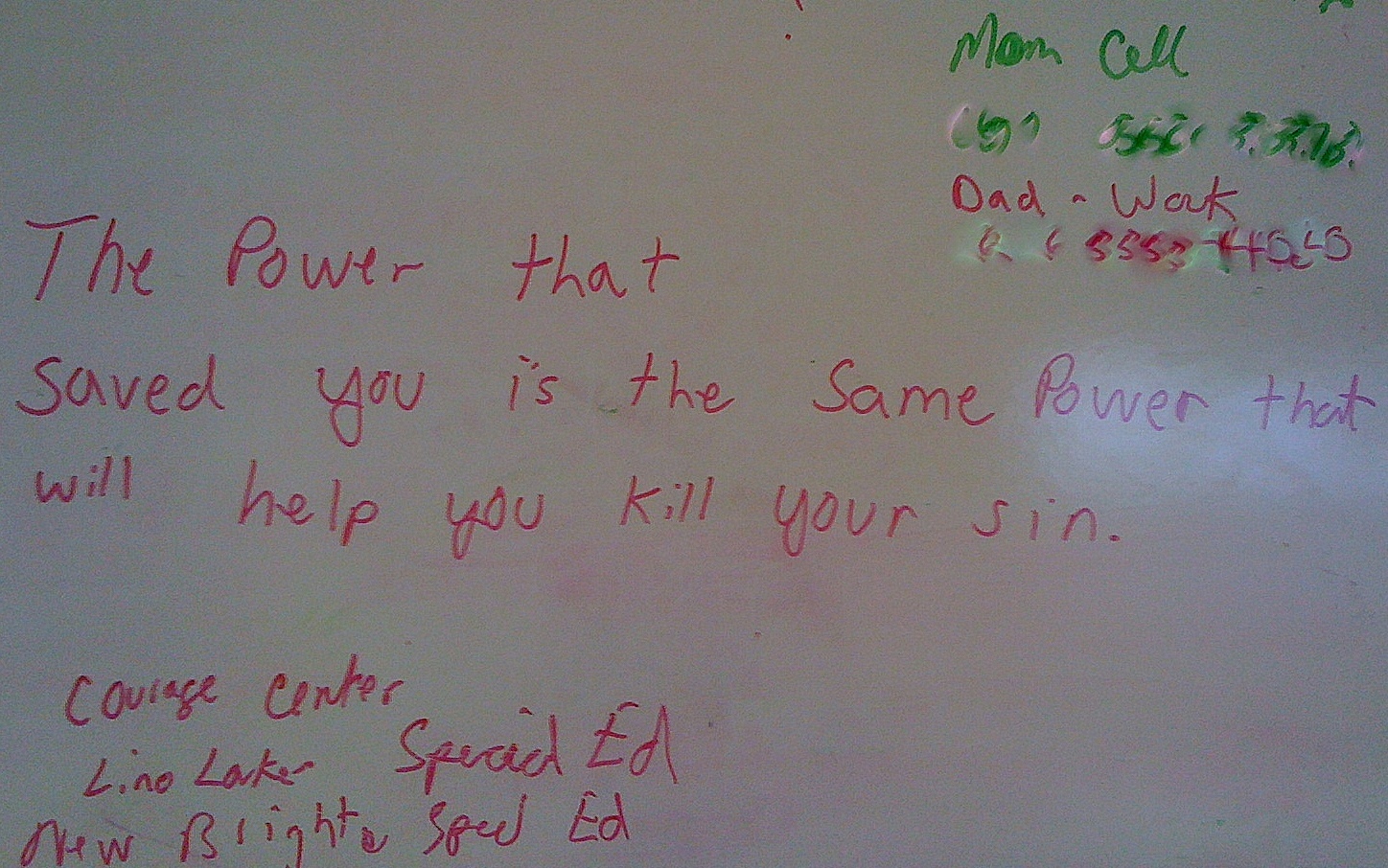
I’m grateful for these reminders!
In the middle of the list of things to do or remember on our whiteboard, I saw this:
I’m grateful for these reminders!
Posted in Uncategorized | 1 Comment »
If you have not yet read Dr. Mohler’s blog from yesterday, The Scandal of Gendercide – War on Baby Girls, I recommend it.
What is amazing is that he is commenting on an article, War on Baby Girls: Gendercide, in The Economist, a secular publication that believes “in free trade and free markets. . .”
Here is some of what The Economist reported:
It is no exaggeration to call this gendercide. Women are missing in their millions—aborted, killed, neglected to death. In 1990 an Indian economist, Amartya Sen, put the number at 100m (one hundred million); the toll is higher now. The crumb of comfort is that countries can mitigate the hurt, and that one, South Korea, has shown the worst can be avoided. Others need to learn from it if they are to stop the carnage.
Why is this happening?
In fact the destruction of baby girls is a product of three forces: the ancient preference for sons; a modern desire for smaller families; and ultrasound scanning and other technologies that identify the sex of a fetus.
Why write about it on this blog? Because those three forces, only slightly altered, could just as easily have been written about the destruction of children with disabilities. Is there any material difference between the three forces described above and these three that result in amazing rates of abortion of disabled babies in our country?
When we become untethered from the Bible, which describes the eternal, foundational, unchanging character and attributes of God and his view of his creation, human beings lose their God-granted value and dignity. Babies become expendable, whether we are talking about girls in China or children with disabilities in America.
The Economist argues that girls in these countries can be saved through economic and educational interventions. I didn’t find a similar argument being made for children with disabilities.
I would recommend a different solution for both: Exodus 20:13 “You shall not murder.”
Posted in Uncategorized | 3 Comments »
I am using the One-Year Tract Bible Reading Plan to help me read through the Bible this year.
For March 9, there was this stunning, breathtaking reality right next to each other in the readings from Luke 23 and Job 38:
Luke 23:44 It was now about the sixth hour, and there was darkness over the whole land until the ninth hour, 45 while the sun’s light failed. And the curtain of the temple was torn in two. 46 Then Jesus, calling out with a loud voice, said, “Father, into your hands I commit my spirit!” And having said this he breathed his last.
Job 38: Then the Lord answered Job out of the whirlwind and said:
2 “Who is this that darkens counsel by words without knowledge?
3 Dress for action like a man;
I will question you, and you make it known to me.
4 “Where were you when I laid the foundation of the earth?
Tell me, if you have understanding.”
We are as nothing before God. How did we ever conceive of the idea that we could question God or his motives or his authority? We were not there when he created all things, and we didn’t (and don’t) have the power to do what God can do.
But Jesus was there.
John 1:1 In the beginning was the Word, and the Word was with God, and the Word was God. 2 He was in the beginning with God. 3 All things were made through him, and without him was not any thing made that was made.4 In him was life, and the life was the light of men. 5 The light shines in the darkness, and the darkness has not overcome it.
The Father gave us Jesus. He who knew no sin became sin so that his righteousness could be given to us. And that Jesus, knowing what he would experience in obedience to the Father, shouted at the most critical moment of all, “Father, into your hands I commit my spirit!” Jesus knew he could trust his Father.
This is overwhelming.
We cannot compare to God on any level. ‘I do not do the good I want’ (Romans 7:19), while God “has distributed freely, he has given to the poor; his righteousness endures forever” (2 Corinthians 9:9).
And this God with that power to create out of nothing who grants us a savior we don’t deserve and a righteousness we could never, ever earn – this is the God we are ready to judge because he creates some who will live with a disability?
The One who has infinite knowledge, wisdom, power, authority, righteousness, holiness and justice should somehow subordinate himself to us because our puny, finite, limited sense of fairness says that God should only behave a certain way regarding disability?
We think we have that right to judge this God? Based exactly on what?
Posted in commentary, Scripture | 6 Comments »
Three books on God and disease, disability, or suffering have arrived in the past two days. I am thrilled!
Sue Hume, who writes Hope for Special Moms, highly recommended Brokenness: How God Redeems Pain and Suffering, by Lon Solomon. Pastor Solomon is the senior pastor for McLean Bible Church, which has one of the most dynamic and comprehensive disability ministry programs in the United States.
Jeff McNair, writer of the blog disabled Christianity and a professor of special education at California Baptist University, recently published five years of his blog in his book, The Church and Disability.
And the one I am probably most excited to receive is a compilation of 25 readings on the problem of pain, which was recommended by Justin Taylor. Justin recently interviewed the editor of this compilation, Nancy Guthrie, on the book, Be Still My Soul: Embracing God’s Purpose & Provision in Suffering.
I hope to read and comment on each in the coming weeks.
Posted in Book Commentary | 4 Comments »
A word on disability and God’s sovereignty from Jim Elliff at Christian Communicators Worldwide: What does luck have to do with it?
Here’s a sample, on God’s sovereignty in the midst of suffering:
I know that it might seem insensitive to say that God is in control. But this is what the Bible teaches, like it or not. When we analyze national tragedy we sometimes recoil from the notion that God could be in control of His world. We seek to protect God from such an accusation. But the Scriptures don’t do this.
That’s exactly right! The Scriptures are unapologetic about God’s sovereignty over his creation.
I don’t know Jim, but Steve Burchett, who works with him, is a parent like many of us. Steve has a beautiful child with disabilities. So, Jim isn’t just writing a good piece using Joni Eareckson Tada’s life as an example. He’s also observing it up close in the life of his friend and colleague.
And that just makes this piece all the better.
Posted in Uncategorized | Leave a Comment »
As promised, here is how the article from yesterday concludes:
These ideals are all wrongly placed as ‘bedrock’ and entirely neglect that God sets the standard for what is right and just. Jesus alone makes us acceptable to God, not through anything we have done or could ever hope to do:
There are no deeper core beliefs possible than trusting in, hoping for and treasuring Jesus. There is no ‘betterment of humanity’ apart from Jesus. He is that rock and that foundation. So we should reject any arguments that seek to elevate human potential or rationality above God’s articulation of himself and his God-centeredness.
Unfortunately, I tend to get self-righteous and satisfied in these moments – “I see things the writer of this article cannot see” – rather than broken-hearted for the writer. God reminded me, again, through my Bible reading this week that I should remember I have had nothing to do with the gift that has been given to me, and that I should be in prayer for and evangelizing the lost around me:
There are so many perishing around us. And so many of them are involved in our disabled children’s lives. Lord, help them to see!
Posted in commentary | Leave a Comment »
When I blogged about a ‘hermeneutic of suspicion‘ a few weeks ago, I should have given them credit for being honest about their assessment of the Bible.
Frequently, we aren’t given that warning. I recently came across an article written in 1997 by Avi Rose, “Who Causes the Blind to See: disability and quality of religious life,”* for the journal, Disability & Society. There was no warning about religious bias or disdain for the Bible.
Rather, the following were offered as a statements of fact:
The root of the apparent alienation of individuals with disabilities by religion may lie in the ancient belief systems of the Judeo-Christian theology which views disability in a highly negative manner. . .
As you can see, the category ‘disability as evidence of a good and sovereign God who has the right and the authority to whatever he wants with his creation, for his glory and for our good’ is missing. Every one of the above categories is presented about as negatively as possible in that article, while trying to sound academic.
And it wouldn’t bother me all that much, except that when disability enters our families a whole army of people also enter our lives. Social workers, doctors, teachers, and other government employees read articles like that and conclude that religious affections are actually bad for us. And because biblical literacy isn’t all that high even in families that attend church, many families stand defenseless in the face of such arguments.
Fortunately, the bias in this article is so blatant, such knowledge isn’t necessary to know something probably isn’t right or fair about the argument being presented.
Tomorrow, the ‘conclusion’ Avi Rose comes to about religion and the Bible.
*Unfortunately I cannot link to that article, but if you have access to an academic library or database, you can find it by searching on the above journal and title.
Posted in commentary | 2 Comments »
Thank you to Justin Taylor for posting yesterday on Nancy Guthrie’s new book, Be Still, My Soul: Embracing God’s Purpose and Provision in Suffering.
I highly recommend watching Justin’s interview with Nancy Guthrie. She has experienced profound suffering herself in her family, and proclaims God as good and sovereign.
I look forward to reading this book, and probably the others she has written as well!
Posted in Book Commentary | 1 Comment »
William Stuntz is a professor at Harvard Law School – and he is dying of cancer. In his very well presented, thoughtful, and ultimately sad question and answer session with Timothy Dalrymple of the website, Patheos, he talks about his cancer and what he is experiencing as a Christian.
Some of his observations are painful for me to read:
There is a tendency that’s especially strong in Calvinist circles to read Romans 8:28, “All things work together for the good,” as though it says that “All things are good.” I heard some of that, and that hurt me too. I am not blaming anyone else; I am sure this is more my fault than anyone else’s. These are honest opinions, if (I think) probably misguided, and they were delivered by completely well-meaning people. But hearing repeatedly that suffering is discipline from a loving Father, and that my circumstances are all gift — no curses, they are all blessings — made me feel sometimes as though God were coming after me with a baseball bat.
Dianne and I had two different reactions to that statement. Here is hers:
And here is mine:
God used the kindness of many people, particularly one couple and their children, to walk and cry with us. They also prayed for us, hoping in and trusting that God would reveal himself and help us. Dianne is right to say that should be our first response.
I also remember when I thought God was coming after me with a baseball bat. I would become angry when people would quote certain scriptures to me. In those moments, the Bible was not a comfort at all, and I occasionally lashed out. Those people who quoted scripture I’m sure felt awful.
But at the moment of God’s choosing, the Holy Spirit has come and shown me the truth and power of God’s word. The same scriptures that made me angry were transformed into comfort and help – this is not the work of any person but God alone.
So, let us be bold to enter into people’s pain, with tenderness and mercy and compassion while also not neglecting the power of the Word of God, even if it is received, initially, as bad and unhelpful news. Persistence in showing up in the midst of pain makes the Word much easier to take.
And most of all, let us ask God for help in those circumstances, for his leading in how we can best serve our brothers and sisters who are suffering intensely. Jesus knows what suffering is, and he is worthy of our trust in leading us in what we should do in those moments.
Posted in commentary | 3 Comments »


Our experiences do not define God
March 13, 2010 by John Knight
On Friday morning I heard this interview with Rabbi Harold Kushner on NPR, author of When Bad Things Happen to Good People. Rabbi Kushner wrote that book after his oldest child died.
What struck me was how many times he made references to ‘I think’ or ‘I conclude’ about God. He made exactly zero positive references, in that interview, to anything other than his own experience and intellect. He was completely untethered to anything except his own conclusions. And that is a horrible way to come to any conclusion about God.
In fact, we are warned against doing so:
The heart is deceitful above all things,
and desperately sick;
who can understand it? Jeremiah 17:9
NPR ended the segment with this quote:
“My sense is God and I came to an accommodation with each other a couple of decades ago, where he’s gotten used to the things that I’m not capable of and I’ve come to terms with things he’s not capable of,” Kushner says. “And we care very much about each other.”
God does not talk about himself as being incapable. In fact, God asserts exactly the opposite. So Rabbi Kushner is either saying God is a liar or that God is delusional about his own abilities. So how can he say that he cares about this God? Why would he say that?
Unless, of course, we create a god in our own image. And that isn’t just sad, it is an offense against the first and greatest commandment: You shall have no other gods before me. Exodus 20:3
Losing a son is horribly difficult; I do not fault Rabbi Kushner for struggling. And after our Paul was born, I know what conclusions my sinful heart lead me to believe and articulate to others. I wrongly concluded that God was powerful, but not kind.
Today, I’m ashamed to remember the words I used to speak about God. I am grateful that God did not leave me in that state – he intentionally and powerfully drew me to himself and gave me an anchor in his word. So Rabbi Kushner is wrong today and I used to be wrong that God’s kindness and power are in conflict. They are, in fact, perfectly and infinitely applied as only God can do, for God’s glory and for our good.
Share this:
Posted in commentary | Leave a Comment »