Feeds:
Posts
Comments

Archive for the ‘commentary’ Category

Yesterday Desiring God posted this interview with David Platt on suffering.  I loved that he started with Romans 8:28!

It is well worth the fourteen minutes.

I am definitely checking out his series on suffering and the cross.

Read Full Post »

Bob Glenn gave a great devotional from Matthew 21 at the Desiring God National Conference on Sunday.  I’ll link to it and comment on it when it is available online.

During his devotional he referenced the ‘great book’ written by Paul Miller on prayer.  I completely agree, and not just because he is also the father of a child with a disability (paragraph formatting mine):

What do I lose when I have a praying life?

Control. Independence.

What do I gain?

Friendship with God. A quiet heart. The living work of God in the hearts of those I love. The ability to roll back the tide of evil.

Essentially, I lose my kingdom and get his. I move from being an independent player to a dependent lover.

I move from being an orphan to a child of God.

Miller, Paul (2009-05-15). A Praying Life: Connecting with God in a Distracting World (Kindle Locations 1664-1667). NavPress. Kindle Edition.

Paul Miller’s conference message at the 2011 Desiring God Conference for Pastors can be found here.

Read Full Post »

Bob Horning is not just the father of Krista Horning and a member at Bethlehem Baptist Church, he also holds a Ph.D. in physics and works as a scientist for Honeywell in Minnesota.  I asked him to take a look at an article in Slate.com, which argued that new technologies are a problem for those of us who hold to the view of unborn life being precious.  Here is his response.

William Saletan writes the column “Human Nature” at Slate.com.  In an article last June called “Fetal Flaw,” Saletan tried to argue several points about prenatal testing, abortion, and the pro-life position, especially in relation to the “problem” of a “defective fetus.”  Briefly, he claimed that:

  1. The developing field of Noninvasive Prenatal Testing (NIPT) will allow earlier, safer, easier and more thorough prenatal screening than current techniques;
  2. Because “earlier tests will almost certainly increase the abortion rate,” pro-lifers must be opposed to the development of such tests.  Therefore, the logical pro-life position is to oppose their implementation;
  3. This opposition means pro-lifers are against both science and public opinion.  He states, “It puts pro-lifers in the politically untenable position of opposing information and health care, not just abortion.”

I believe that is an honest and fair summary of the article.  You can feel free to correct me if you see it otherwise.  I say that he “tried to argue” because he did a very poor job of it, although he obviously did not see it that way.

It’s not hard to see where the logic disappears.

Point 1 is the only accurate part of the article.  It’s actually very true, and people of any political persuasion can see that.  And praise God for good science!  Twenty-five years ago when our daughter was born, things like this didn’t exist.  If they had, it wouldn’t have changed whether or not she was born.  She was and is a human being, our precious baby, and now our dear 25-year-old daughter.  Testing wouldn’t have changed that but it would have helped us prepare for the upcoming days, months and years.  Disability (I will not use the word defective) is not easy, but it is not a reason to kill a human being.

That brings me to point 2.  Saletan says, “The separability of testing from abortion, coupled with the bundling of testable diseases and the ambiguity of how the findings will be applied, makes moral regulation of prenatal testing a logistical nightmare. It puts pro-lifers in the politically untenable position of opposing information and health care, not just abortion.”  In other words, the only position pro-lifers can have is to oppose prenatal testing.  He drags out a few examples (former presidential candidate Rick Santorum and a bill from the Virginia Legislature) to prove his point.  There are three serious flaws in Saletan’s thinking.

  1. An increase in abortions does not have to be an “almost certain” result of NIPT.  It’s true that more abortions are one possible result, but that’s not because of the testing.  That result comes from the unspoken assumption that the fetus has no intrinsic value.  When a physician finds a blocked artery or a malignant tumor or the beginning signs of Alzheimer’s disease in an adult patient, she doesn’t therefore say, “It’s time to kill this patient.  He’s going to either die soon or be a burden to his family.”  Instead she begins to prescribe treatments, therapy and lifestyle changes.  Why?  Because most people in our society (although not all, unfortunately) still believe the patient has intrinsic value and we should try to save his life.  The problem is, the worldview of our society has degraded to the point where “defective fetuses” are no longer accorded that same value.  They are defective, they are a problem – these two words are found in the first sentence of Saletan’s column – and they are powerless.  So don’t bother treating them, abort them.  It is not testing or test results that kills babies.  It is a worldview, mercilessly advocated by Saletan and many others, that leads to this result.
  2. Many pro-lifers are very supportive of good science and good tests. I do, for one, and I can point to many others.  It is true, as Saletan demonstrates, that some pro-lifers do oppose prenatal testing. I suspect many pro-lifers oppose prenatal testing because they haven’t taken the time to think about alternatives other than abortion.  If they do, most of them would agree that the battle isn’t against good science, it’s against a wicked worldview.
  3. Saletan’s final flaw here is that he doesn’t seem to believe there is a viable alternative.  In fact he points to it, albeit rather crudely, in his last paragraph.  “But the best way to separate testing from abortion is to push the technology forward so that we’re fixing defective embryos and fetuses, not just discarding them. Who could be against that?”  Although that last question is meant to be hypothetical, he spent the entire column pointing out that the answer is “pro-lifers, of course.”  He can see the alternative but obviously doesn’t really believe it.  Stated differently, Saletan does believe that defective fetuses can be fixed, and most likely believes that some will.  But the article clearly shows he believes most will just be discarded. And there is not a word in the article suggesting that he thinks there is anything wrong with that.  There are plenty of good alternatives to abortion.  Yes, some babies can be treated before birth, but we all know that most disabling conditions cannot be “fixed.”  Instead, those results can give parents the time to prepare their hearts and their homes, gather support, pray.  The results give us, the Church, time to surround those families with love and compassion.  Yes, the church needs to do better at this.  I need to do better at this.  It certainly wouldn’t hurt if Mr. Saletan would spend more time promoting this kind of “fix” rather than finding reasons to kill another baby.

In answering Point 2, I’ve also answered most of Point 3.  We don’t oppose science, or information, or health care.  Exactly the opposite is true.  In fact, for decades pro-lifers have fought for the right of pregnant women to have accurate and complete information about the child in their womb, the physical and psychological risks of abortion, and the alternatives available.  Pro-abortion forces have vociferously opposed any and all attempts to inform the mother despite (as Saletan details in the article) the fact that most Americans oppose an unlimited right to abortion.  Polls do show that Americans are less opposed to abortion when the fetus is “defective.”  Let’s start using language that isn’t so biased. People of God, put more action to your beliefs (i.e., show your faith with your works).  Let’s start calling those babies children, created in the image of the God of this universe, rather than defective fetuses.  Above all – though I don’t know if  Mr. Salentan would agree with this – let’s teach mothers and fathers and families that there is good news that far outweighs this affliction, and it is found in God’s one and only Son.  And then let’s see how public opinion changes.  And even if it doesn’t change, killing babies is still wrong and always will be, just as killing blacks or Jews or Tutsis is and always will be wrong.

No Mr. Saletan, the best way to separate testing from abortion has nothing to do with pushing prenatal testing technology forward.  The best way to separate testing from abortion is by providing love and care and hope to them and their parents, not just discarding them. Who could be against that?

Read Full Post »

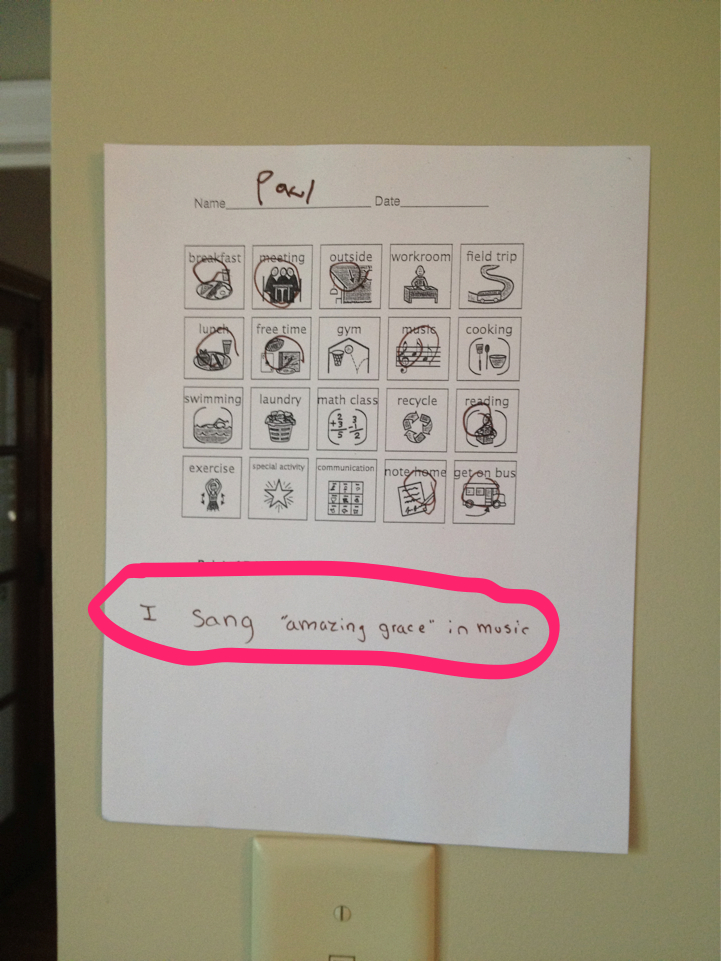
Almost every day Paul’s teachers send home a report that quickly lets them summarize his daily activities.  At the bottom they note something he may have learned or accomplished that day as a ‘point of pride.’

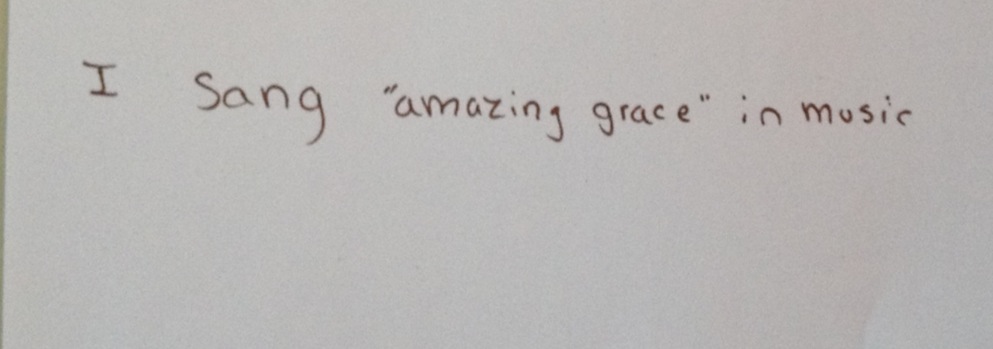
Last Wednesday he came home with a simple note:

His bus aid also serves in his class and told me the same thing, adding, “I felt like I was at a revival!”

Who knows, maybe he was!

Jesus answered, “Truly, truly, I say to you, unless one is born of water and the Spirit, he cannot enter the kingdom of God. That which is born of the flesh is flesh, and that which is born of the Spirit is spirit. Do not marvel that I said to you, ‘You must be born again.’ The wind blows where it wishes, and you hear its sound, but you do not know where it comes from or where it goes. So it is with everyone who is born of the Spirit.” (John 3:5-8 ESV)

My Paul needs help with almost everything.  And though we’ve met some really fine Christians at his school, I’m sure there was no prompting from any of them for a hymn.

But when God says, “tell them about me, Paul” – he sings!

Read Full Post »

In her contribution to The New York Times Motherlode blog, Pregnant at 49, Erin Kelly lays out the challenges she sees in being pregnant, unexpectedly, at the age of 49.  Rightly, the issue of the baby’s genetic makeup is central to her concerns.  Women at that age (and men, as it turns out), are of greater risk in having children who will be born with genetic anomalies.

Every statement she makes about disability is negative, except one:

Yes, we know disabled people can lead productive happy lives.

Which was immediately followed with this:

But he and I agreed we’d terminate a fetus with genetic defects. Why? Not because we’re crazed perfectionists, or evil. We’re just too old.

Actually, the statements that follow this suggest they are perfectionists:

We’re already almost too old to properly raise a special-needs child. We’ll certainly be too old later. If we live until about 80, that’s 30 more years. This special-needs child would be a special-needs adult with a long life ahead when we died. After my grandmother died, I watched my aunt with Down syndrome move between her sisters for more years than she’d had a mother. Our daughters would automatically be made into their sibling’s keepers. I always wanted three children, but we’d be giving them a lifetime of responsibility for a decision we made to indulge ourselves in having another baby to fill our emptying nest.

There is no statement about how her aunts felt about taking care of their disabled sibling.  There is no statement about what kind of life her aunt with Down syndrome lived; many adults with Down syndrome would say they lead a very good life.  There is no statement about families taking care of each other.  Yet, I’m sure if one of her teenaged children suddenly experienced a traumatic brain injury this mother would be the first in line to take care of that child for as many years as she was given – even into that child’s adulthood.

But there is a lot said about the value of independence and productivity over dependence.  Notice even in the ‘positive’ statement: we know disabled people can lead productive happy lives.

And, curiously, there is no mention of adoption.  If they are too old to parent, maybe somebody would take on the challenge.  I know quite a few of those ‘somebodies’ who have adopted children with special needs – sometimes many children!

Sadly, this baby died through miscarriage, so we will never know what kind of person he or she would have been.  Maybe that’s a kindness from God; Erin Kelly was not put in the position of explaining to her children why she aborted their sibling because he or she was too defective to live.

And she concludes with a statement about who gets to decide things, like what makes up a good family or not:

My experience is just one more reason I believe women must have an absolute right to choose whether to remain pregnant with no exceptions. Some pregnancies aren’t only about the survival of the mother or the fetus, they’re about how the whole family thrives.

Whole families – except, of course, for the one you didn’t want.

Paul taught us there is something worth sacrificing for, including caring for and loving children who will suffer and who will bring suffering to an entire family, because it leads to something of greater worth than anything – Jesus Christ!

Indeed, I count everything as loss because of the surpassing worth of knowing Christ Jesus my Lord. For his sake I have suffered the loss of all things and count them as rubbish, in order that I may gain Christ and be found in him, not having a righteousness of my own that comes from the law, but that which comes through faith in Christ, the righteousness from God that depends on faith—that I may know him and the power of his resurrection, and may share his sufferings, becoming like him in his death, that by any means possible I may attain the resurrection from the dead. (Philippians 3:8-11 ESV)

Read Full Post »
I have a friend in one of the current violent hot spots of the world.  He is bringing the good news to a very dark place spiritually.

And he is the parent of a child with a disability along with some other serious health issues in other members of the family.

I don’t know how many missionary families there are in the world who are also experiencing disability, but I know it is more than one!  And, realistically, every missionary family will be confronted by disability because disability is everywhere.

I am feeling Paul’s call to the church in fresh ways:

Rejoice always, pray without ceasing, give thanks in all circumstances; for this is the will of God in Christ Jesus for you. (1 Thessalonians 5:16-18 ESV)

I emailed my friend because I was concerned about him and wanted him to know I was praying for him.  Here was his response:

All good here… It’s just letting the world see what we already know the reality to be…

I’m not sure what I was expecting, but that hit me right between the eyes with its truth!  The reality of sin is so dark and so twisted, yet we seek to hide it in pretty packages of intelligence or wealth or power.  Those violent images on my screen don’t even begin to show how truly evil we are without God giving us beating hearts for him and spiritual eyes to see.

Our primary problem is not disability.  Sin is far worse.

Please pray for those in dangerous places who God is using to bring his glorious light into darkness.

Read Full Post »

We knew we would have a significant need for volunteers (again) for the disability ministry, and it was particularly true at the North Campus.  Many prayers were being offered up to God.

God brought a godly man, a long-time member at Bethlehem, with skill in videography and a heart for the ministry to Brenda Fischer, our disability ministry coordinator, with an offer to make a free video.

That video showed this past weekend, just two weeks before everything kicks off and with a large need for volunteers remaining.

God moved – addressing the entire need for volunteers at the North Campus in one day and giving the North Campus two available substitutes!  Brenda summed it up really well when she told me, “isn’t this awesome!”

Yes, it is, because God did it all, and we’re happy to give him all the glory and to freely enjoy the benefits of his kindness toward us.

Rick Busch is the man who did the video below. I’m grateful God put us on his heart, and also grateful God provided some immediate encouragement to Rick’s work.

We haven’t stopped praying – our needs continue to be significant.  And we would be pleased to have even more families join us, though it will once again strain Brenda and her team’s ability to respond.  God will help.

Read Full Post »

I met a really remarkable young man yesterday.  He’s leading his family through what will likely be the death of his youngest son.

Michael and his wife started a blog to keep their family up to date on how their son was doing.  It has expanded far beyond that inner circle to encourage many, including me.  I highly recommend it.  Here is a taste:

We have death all around us.  However, it is not all that we have around us.  We have grace all around us too.  Like author Paul Tripp says, God, in grace, is using death to lead us to where life can be found.  There would be no way for us to endure this impending physical death without the promise of spiritual life in Christ.  If this life was ultimate, we would be in despair.  But because we have eternal life in Christ and his resurrection we believe that the time Henryk is here is a piece of the thread of his life that will go on into eternity.  We are so blessed to have this time with him.

Please pray for this young couple.  These days are hard in ways that can’t be fully described.  And God is good.

Read Full Post »

63 years ago today my parents married.  My mother reminded me last week that she’s known dad since she was three!


Dad needed surgery last week on his heart, so they’ll celebrate today in a hospital.

I had the chance to pray with my dad before his surgery and thanked God for my Psalm 78 father:

He established a testimony in Jacob
and appointed a law in Israel,
which he commanded our fathers
to teach to their children,
that the next generation might know them,
the children yet unborn,
and arise and tell them to their children,
so that they should set their hope in God
and not forget the works of God,
but keep his commandments;
(Psalm 78:5-7 ESV)

If you’re curious to meet this man, I’ve written about him before here and here.

I’m grateful to God for the common grace of medical care, but even more grateful for the uncommon grace of being into a home that trusted and trusts God in all circumstances.

Read Full Post »

Pastor John’s message last weekend, He Stood by Me and Strengthened Me for the Sake of the Gospelincluded some very personal reflections on his own sorrows in ministry.  He followed it up with a blog post yesterday, More Thoughts on Friends Who Fail You.

We all fail; the number of people I’ve failed is too high to count.  But I feel even more acutely ashamed of the times I intentionally tried to hurt people – people often trying to do me good – for their failures: using the wrong words for a disability; suggesting the wrong therapy; not ‘getting it.’  And because it involves disability, the culture gives us the ‘right’ to find offense wherever we look.  I’ve touched that topic before here and here.

So the message and the blog posting were good words for me as we live this unusual life of disability in this hostile culture with people who fail and who I fail.  Especially the closing to the blog post:

We look to Jesus not only because he was the great model of holding onto friends who let him down, but also because he died and rose again to be the joyful bond of broken and restored friendships.

So keep Jesus before your eyes, and pray this into your heart: “Love bears all things, believes all things, hopes all things, endures all things. Love never ends” (1 Corinthians 13:7–8).

Whatever you do, don’t let the failure of your Christian friends become the basis for abandoning the one Friend who never fails.

Read Full Post »

« Newer Posts - Older Posts »