Feeds:
Posts
Comments

Archive for April, 2011

It has been a hard couple of days for Paul.  He had a bad spell on Friday and again on Saturday.

God’s word is a comfort.

No, more than that: an answer.

I bless the Lord who gives me counsel; in the night also my heart instructs me.

I have set the Lord always before me;
because he is at my right hand, I shall not be shaken.

Therefore my heart is glad, and my whole being rejoices;
my flesh also dwells secure.

For you will not abandon my soul to Sheol,
or let your holy one see corruption.

You make known to me the path of life;
in your presence there is fullness of joy;
at your right hand are pleasures forevermore.

Psalm 16:7-11

That passage was part of my reading for April 9 and God used it in strengthening me for the day.

I’m grateful to those who recommended that I read through the Bible in a year, though it took me a long time to actually do it.

I offer the same recommendation to you – why not begin today?

Read Full Post »

On Thursday Paul had a letter in his backpack from the Superintendent asking parents to contact legislators about public financing for Saint Paul schools.  The whole letter can be found here.

I had one of those moments of just shaking my head as I read these sentences:

We are required by law to provide special education services.  Freezing special education funding without reducing services amounts to an additional cut of $3 million.

This money will have to be made up from our general fund. The likely result of this cut will be increasing class sizes and the elimination of all day kindergarten.

Ok, where do we begin with what’s wrong with this?  I’ll just stick with two.

First, this is a false dilemma.  The Saint Paul Public School budget for the 2010-11 academic year is $623 million, and they began the year with a $59 million fund balance. They have numerous options for how money can be moved around, spent or not spent.  To assert that because their hands are tied in one area means they have only one option in another is simply not true.

Second, the superintendent is pitting the needs of students with disabilities against typically-developing students.  There was a reason why she chose those two groups of children. Read those above sentences from the superintendent again.  It could also read this way: if we could, we would take money away from children with disabilities and make sure we have programs for students who really deserve it.

Frankly, I don’t know if St. Paul Public Schools needs more money or not, if they spend too much money on special education or not, or need all day kindergarten or not.  So I’m not going to comment on the merits of what she was asking parents to do.

But these subtle statements about being handcuffed by laws governing special education just feed the cultural disdain for people with disabilities.  ‘They’ are expensive, less worthy than others, and interfering with our plans.

I hope for better from public officials, especially those working in institutions dedicated to serving children.

But, it is a reminder there is lasting hope only in the One who has regard for those who are considered lesser in this present age.  And he speaks a blessing on those who have regard for the weak:

Blessed is the one who considers the poor (or weak)! Psalm 41:1a

Read Full Post »

Justin Taylor had an encouraging post that 15 states are considering banning abortion after 20 weeks of pregnancy.  I found the Iowa bill that was passed by their House, and it didn’t include the abhorrent ‘except for fetal anomaly’ clause that can be found in other countries like the UK.  That was encouraging as well.

But we are looking for something even greater, and it will only come with God’s help!

The political goal of making abortion illegal has always been a truncate vision. Our real desire has always been to create a culture where abortion is not just illegal, but unthinkable. In such a culture, the physical, psychological, and spiritual dangers of abortion will be common knowledge. In such a culture, commitment, compassion, and a sense of duty to aid and protect both mother and child will be universal.

Biomedical Ethicist David Reardon, as quoted in A Hunger for God by John Piper, pp. 163-164.

Read Full Post »

On Tuesday Dianne and I concluded our talks on God’s goodness to us through disease and disability to the MOMS Group (Making Our Mothering Significant) at Bethlehem’s three campuses.

I learned a few things in this process.

  1. I really, really appreciate my wife (ok, I didn’t learn that one – I already appreciated her!).  We’ve never done anything like this together and I enjoyed doing this with her.
  2. It is good to remember what God has already done for us.  And very personally encouraging.
  3. Dianne tells our story differently than I tell it, and it seems to land on people with a different kind of power and evidence of God’s goodness.  I liked that.
  4. I love my church (ok, I knew that one as well.  But being at the north campus with those sisters in faith was just incredibly great!).
  5. Disability really is foreign (and scary) to some people.  It used to be foreign to me, so that should be obvious.  But I forget that.
  6. Christian hedonists don’t need to know much about disability to ‘get it’ that God is sovereign over disability.  That’s refreshing.
  7. We must keep telling our stories about God’s goodness in disability, and point out how God talks about disability and his sovereignty in his Word.  This particular aspect of God’s sovereignty – that he is both sovereign and good in disability – is worth visiting over and over again.

Thank you, MOMS, for letting us be with you!

Read Full Post »

On Tuesday Dianne closed her talk to about 40 mothers on the topic of God’s goodness in disability with this gem from Martin Lloyd-Jones:

You may not understand what is happening to you; it may seem to you all wrong. Trust yourself to (God). Believe when you cannot prove. Hold on to his constancy, his justice, his eternal purposes for you in Christ. Regard these as absolutes, which can never be shaken, confident that ultimately all will be made plain and all will be well.

The man knew how to pray as well!

Read Full Post »

Now a ‘what’ but a ‘who’!

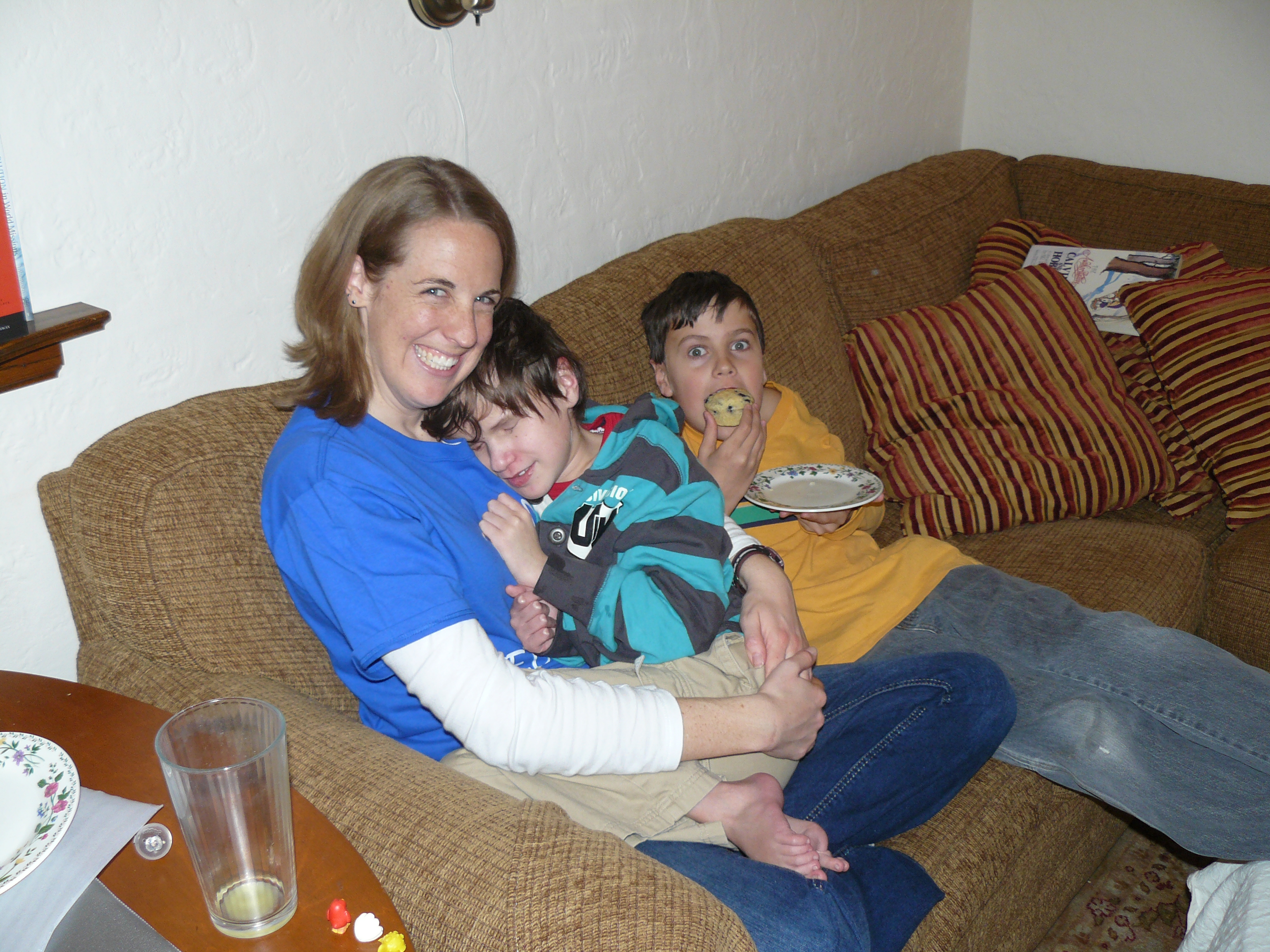
My niece came to visit this past weekend, and she was able to coax a few smiles out of our boy (and a lot of smiles out of the rest of us!).  Those smiles have been few and far between with these spells of his, so that little smile on his face is like gold.

God is kind to provide good gifts, like people who can light up a house with their presence!

A glad heart makes a cheerful face. Proverbs 15:13a

May God be pleased to provide such a person in your life today.

Read Full Post »

Dr. Reinders was right – our “Christian liturgy is replete with songs and prayers full of the promises of what God will do.”  Maybe those old hymn writers knew something about suffering and providence worth remembering and even clinging to today.

For example:

Now Thank We All Our God:

Now thank we all our God, with heart and hands and voices,
Who wondrous things has done, in Whom this world rejoices;
Who from our mothers’ arms has blessed us on our way
With countless gifts of love, and still is ours today.

Immortal, Invisible, God Only Wise

To all, life Thou givest, to both great and small;
In all life Thou livest, the true life of all;
We blossom and flourish as leaves on the tree,
And wither and perish—but naught changeth Thee.

Praise to the Lord, the Almighty

Praise to the Lord, who hath fearfully, wondrously, made thee;
Health hath vouchsafed and, when heedlessly falling, hath stayed thee.
What need or grief ever hath failed of relief?
Wings of His mercy did shade thee.

And there are some old verses in familiar hymns I think we should bring back!

A Mighty Fortress Is Our God

With might of ours can naught be done, soon were our loss effected;
But for us fights the Valiant One, whom God Himself elected.
Ask ye, who is this? Jesus Christ it is.
Of Sabbath Lord, and there’s none other God;
He holds the field forever.

Read Full Post »

Pastor John started his sermon on March 20 noting that “it is possible to live in an evangelical, Bible-believing, Bible-loving world and never hear the criticism of the Bible that is commonplace in university religion departments around the country and in the classrooms of many mainline churches.”

The opposite is also true.

Dr. Hans Reinders writes frequently on the topic of theology and disability, and I have found him to be an interesting voice.

But he surprised me in his most recent article in the March 2011 Journal of Religion, Disability and Health, “Is There Meaning in Disability? Or Is It the Wrong Question” where he writes:

(T)he notion of providence does not seem to do much work in the life of contemporary Christianity.

Even though Christian liturgy is replete with songs and prayers full of the promises of what God will do, there is not much attention paid to the notion of providence in contemporary theology.

Apparently, it is not a topic that weighs strongly on people’s minds. (Emphasis mine)

Really?  I think about it a lot!

I’ve been to conferences with several thousand other people who also think about it a lot, and they go on to preach in churches to hundreds of thousands of others, who learn to pay attention to the notion of providence.  We had more than 3.5 million ‘unique’ visitors to the Desiring God website last year – I think most of those probably also pay attention.  Even Time Magazine noted the rising influence of ‘The New Calvinism’ a couple of years ago.

I’m not making fun of Dr. Reinders; his world is different than our evangelical world.  It takes effort to look outside our bubbles.

I know I’ve seen his email address somewhere in my studies. I’d like to let him know there are significant scholars like D.A. Carson and Al Mohler who take providence very seriously.

It would be good to have a scholar of his standing (he was just named Editor-in-Chief of The Journal of Religion, Disability and Health) paying attention to those who take the sovereignty of God over all things, including disability, seriously.

Read Full Post »

I’ve been enjoying reading a new blog, The Works of God Displayed.  Thank you, Shannon, for leaving a comment and a link to your blog!

We share some values, like this statement from her blog a few days ago:

If you want to minister to and with people with special needs, I don’t suggest that you study disabilities first.  Study people instead.

Become a student of your families. Ask questions about strengths and weaknesses, about what the person does and doesn’t respond well to. Don’t make assumptions based on what you know about the disability; learn all you can about the person. . .

All of the books and methods and strategies out there recommending formulaic ministry are missing one truth: Jesus didn’t use formulas. He loved people. 

Shannon has an MAEd in Special Education, which is obviously helpful in thinking about a disability ministry.  But she also recognizes that God provides help for those he calls:

While my background helps and while I know other special needs ministry coordinators with similar backgrounds, it’s not necessary. Because, experienced or not, it’s God who is ultimately in control. If we truly believe that there is a biblical basis for special needs ministry, then we also can believe that God is able to provide and equip the right person to lead it at your church.

I frequently reference 1 Corinthians 12:22 here (On the contrary, the parts of the body that seem to be weaker are indispensable) and usually I’m referring to those who live with disability, especially developmental disabilities.

But I would suggest it also refers to people who don’t feel qualified to be in this ministry for any number of reasons: lack of experience or education, unfamiliarity with disability, the fear of doing or saying something wrong, prior bad or difficult experiences.

Most people feel entirely unequipped to be part of this ministry.  Yet, that’s who God delights to equip!  It shows him to be even more glorious when he takes scared, inexperienced, uneducated people who trust him, and then they frequently develop deep affections for the people God has called them to serve.

And those same unequipped people frequently discover this secret – they are served as well, often believing they are the ones getting the greater blessing!

Of course, he also delights in those who seriously prepare themselves for their vocations through education and professional engagement – and who ultimately trust in him to provide what they need as they serve.  God will always know a whole lot more than anyone ever will about disability and his purposes.

Read Full Post »
I like to live with the thought that my grandparent’s generation was better than mine – more noble, less sinful than this present age.  I think there is evidence that was the case.

But there is also evidence that they shared some of this culture’s evil intentions toward those with disabilities, like this finding from a study done in the 1930’s:

A majority (54%) also favored the most radical eugenic measures, government supervision of “mercy deaths” for “hopeless invalids.”  Public Opinion Quarterly, vol 2., July 1938, pp. 390-91 as quoted in Three Generations, No Imbeciles by Paul Lombardo, p. 221.

We must stand for those the culture would destroy today, and teach our children to do so after we are gone.  Not in their own strength, but in the knowledge of and hope in who God is:

He established a testimony in Jacob
and appointed a law in Israel,
which he commanded our fathers
to teach to their children,
that the next generation might know them,
the children yet unborn,
and arise and tell them to their children,
so that they should set their hope in God
and not forget the works of God,
but keep his commandments;
and that they should not be like their fathers,
a stubborn and rebellious generation,
a generation whose heart was not steadfast,
whose spirit was not faithful to God.

Psalm 78:5-8

Read Full Post »

« Newer Posts